If you work within the web world, it all just makes sense.
We all know what SEO is, what SEM is, what PPC is, how search engines work, and how it all relates to building websites and performing well in the web world.
But for the everyday Internet user, these are likely not things that you think about on an everyday basis. Or you may have just heard these terms for the first time and wondered what it all meant. Believe it or not, simply understanding the basics I am describing here may help you become a more proficient Internet user as a whole; and if performed properly, the SEO tactics that follow should help you improve the amount of traffic that comes to your website naturally (i.e. at no cost to you).
For starters, let me define these three key acronyms:
- SEM - Search Engine Marketing
- PPC - Pay-Per-Click
- SEO - Search Engine Optimization
Let me begin with Search Engine Marketing, as this term is very broad and fairly simple to explain. Anyone who utilizes search engines to market their website is doing Search Engine Marketing, or SEM. This includes Pay-Per-Click and Search Engine Optimization, as well as other techniques, such as Social Networking or link building.
What about PPC?
The most common term associated with SEM is Pay Per Click, or PPC. PPC is the act of just what it sounds - paying for clicks. This is done via search engines such as Google or Yahoo, as well as others such as MSN or Ask.com. Any company that performs PPC does so by placing bids on keywords through one or more of these search engines. They then pay each time that ad is clicked on (but not until it is clicked on). This can be as simple as setting a bid price on a few of the terms most closely associated with your website, or as complicated as bidding on thousands of keywords and keyword groups that research has proven to be commonly used by users who are interested in a website such as yours.
When you perform a search within any search engine - lets say Google for the sake of simplicity - you get two types of results: paid search results and organic search results. Lets pretend I was interested in purchasing a copy of "The Tao of Pooh" online. I go to Google and I search "Tao of Pooh". This takes me to a results page that Google has populated for me. At the top of the page, I will likely see a few links with a yellow background (and if you look closely, you will notice a label at the top of this area that says "Sponsored Links"). There are also likely a handful of links on the right side of the screen (also with a subtle "Sponsored links" label at the top). These are paid search results and are, as you would guess, the product of PPC. All other results are called organic, or natural, results. So now we know where paid search ads come from and have a vague idea of how Google and others decide to put them there.
What about the rest of these other organic results, right? Well that's where SEO comes in.
So then what is SEO?
SEO, or Search Engine Optimization, is the act of optimizing a website such that search engines "like" your site. Unfortunately SEO is no simple science, but that is the beauty of it. Search engines have what are called search algorithms, or extremely complex rating systems, that have the power to decide how relevant your site is to any given keyword search based on a variety of factors. Where PPC is driven by the amount that is being bid on a keyword, SEO is being driven by how relevant your website is to the given search term(s). Sounds scary, but the wonderful thing is, the better their algorithm, the more likely you are to end up landing on a website that is exactly what you were looking for.
How do Search Engines Work?
When a search is performed, the search engine sends its "spiders" out to crawl every website on the Internet. Then, using their search algorithm, they are able to rate which of those sites is most relevant to the given search term(s) and return those results to you in order or their rated relevance. Although few people know exactly everything that is on that algorithms ever-changing mind, there are a number of factors in a websites content, design and structure that are given a great deal of importance. Relevancy is key - the more relevant a site is to a given search term or group of search terms, the more likely your site is to appear organically. But how do you prove that your site is more relevant than another site, when there are so many other sites out there?
More Specifically, how do I Effectively Perform SEO?
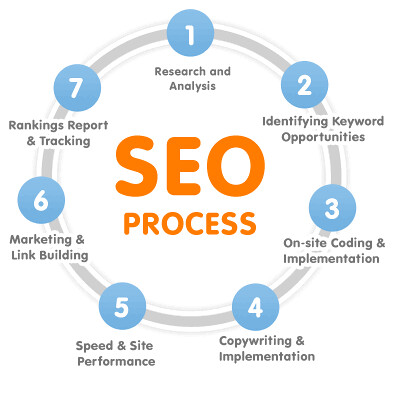
Aha, so now you want to know the key? Well again, there is no perfect science to it, but here is what I have gathered over time as the most important aspects of SEO that should help you focus your to improve your site's organic search results:
- Keywords:
The keywords that are used within your site should be relevant to your sites content and should be chosen such that any user who is interested in your product or service would likely be searching using terms that are contained within your site content. Make sure that the most prominent keywords make up 3-5% of your site content. -
- Links - inbound as well as internal:
Search engines view inbound links as important because it shows that sites other than your own have some interest in your site and therefore gives your site legitimacy and relevance. Links within your site that link to other pages within the site are also considered important, as it shows your site is organized in a way that improves the user's experience. Pages on your site that have nothing linking to them are not going to help your site out in any way. -
- Site history:
Although this is not something you can change on the fly, it is true that if your site has existed for some time, you are going to have a better time at coming up higher in search results. -
- Original content:
If you are using content that exists elsewhere, your site will be punished for it. I recommend always having original content on your site - even if it is only subtly different. -
- Meta tags:
These are just keywords and descriptions that live within the code of you site that tell search engines what your main keywords are and provide a description of your site. If these are omitted, you are missing out on a great chance to tell the search engine a lot about your site and are likely going to be dinged pretty good by the search engines. -
- Site code and structure:
There are many ways that sites can be coded to be more cleanly and more ideal for search engines. If you have the opportunity, have someone look at your site's code to ensure that you do not have excess code, that you are tagging all of your images and other elements appropriately, and especially if your site is flash-based, that your site has html files associated with those flash files so that there is text for the search engines to read.
I hope that this guide gave you a good intro into the wonderful world of online marketing and all that it entails! Feel free to let me know if you would like to learn more about any of this and I will certainly be happy to take it a step farther. Happy searching!
Search engine optimization aims to ultimately achieve the goal to getting more people to a website by helping it get higher rankings in the major search engines. This simply implies that s.e. optimization's goal is to create a website appear on the first pages, if not the first page of a search done through the internet search engine.
You will find two methods to be capable of geting noticed by se's. One is through pay-per-click-advertisements. Among a pay-per-click system that is used by search engines may be the Google Adwords system. It has created a hype and it has given Google around 5 billion dollars when it comes to revenue each year. Webmasters can place their bids to be shown each time a keyword is searched by way of a surfer. The best bidders will get their web sites to seem first when the search will be done. The second way of getting high rankings from search-engines is through organic searches. Search-engines evaluate web sites by utilizing what they call “ spiders. ” These programs scan the web sites and collects information about them. They then collate the information and pass it on to the internet search engine. This area is primarily the primary arena of search engine optimization. It utilizes some methods to be able to get se's to list the website on high ranks.
The main reason for search engine optimization is to boost the traffic generated with a website. Web sites are built to be seen by Internet surfers and se's can help it accomplish that goal.
The power of the
professional seo company really should not be underestimated. It is among the foundations of the foundation of the Internet. A survey showed that 90% of all Internet surfers employ se's to help them within their Internet-related activities. Google, the dominant player in the s.e. industry, generates 70% of most search-related Internet activity.
People and Search-engines are alike
Search engines
One most desired topic is "Search Engine Optimization (SEO). "
In addition, it features articles about web marketing and web site promotions. It is a one stop-site for Search engine marketing and so many more related topics. The site is also user-friendly, is simple to navigate and allows user interaction.
Most of the topics available at the website could be very useful to e marketers/telemarketers, website consultants and bloggers who would like to optimize their search engines.
Topics like "Boost your rankings with Pagerank Sculpting", "Consider employment searching Engine Marketing" and "Why SEO is essential for your Web Site" and so many more - are just some of the of good use SEO topics in the internet site.
3. SearchEngineChannel
A number of the significant articles are: "Social Media and your Search engine optimization Strategy" and "Small Business SEO - 5 Top Search engine marketing Tips".
It's a blog that has SEO articles as its featured posts: "31 Days to Creating a Better Web log, Seo " and "Google Optimization Secrets From the Trenches" are two of the very helpful articles.
5. S.e. Genie: Magician for Internet business
There are various topics featured in this web site and the articles about SEO must be read by everybody who would like to optimize her/his s.e..

